WHAT WE SOLVE
Change usually shows up as a business problem first.
Most organisations do not wake up saying, “We have an adaptability problem.” They notice something more immediate: customers complain more often, work takes longer, roles become unclear, or a new system does not deliver what was expected.
I-Vine helps organisations understand what is really driving those problems and determine what needs to change.
01
Customer friction: Customer experience is getting harder to manage
Customers may have changed what they expect, while the processes around them have barely changed at all. The result can be repeated contact, avoidable escalation, inconsistent service, slower resolution or teams constantly making exceptions.
Sometimes the customer journey, process, handoff or decision authority needs to change. Sometimes people need greater capability. Often, both matter.
02
Growth friction: Growth has created problems that did not exist before
Ways of working that were perfectly adequate at one stage of a business can become obstacles at another. As organisations grow, responsibilities spread, handoffs multiply and decisions that were once simple become more complicated.
The question is not simply whether the business has grown. It is whether the way the organisation works has grown with it.
03
Technology friction: Technology has changed, but the work around it has not
Introducing a new platform, automation or AI tool does not automatically create better performance. The technology may work while roles, judgement, workflow or management practice remain designed for the old way of working.
I-Vine looks at both sides of the problem: the technology itself and the capability and working practices around it.
04
Role and skill friction: Roles have changed faster than people’s development
Roles rarely change overnight. More often, responsibilities accumulate gradually. A manager takes on more decision-making, a customer-facing employee handles more complex cases, or technology removes one part of a job while increasing the judgement required elsewhere.
The challenge may require reskilling, clearer responsibilities, redesigned roles or a combination.
05
Leadership friction: Teams cope with familiar situations but struggle when things stop being familiar
Procedures are useful when the situation fits the procedure. The difficulty comes when it does not. Managers and teams increasingly need to make sound decisions in situations they have not encountered before.
This is where adaptability becomes a capability rather than a one-off response to change.
06
Operational friction: Procedures that once worked now create their own delays
Processes are usually built for the situation they were designed to handle. Over time, exceptions accumulate, handoffs multiply and workarounds become the normal way of getting things done. The procedure has not changed, but what it is being asked to handle has.
The fix is not always a new process. Sometimes it means removing a step, clarifying who owns a decision, or recognising that a workaround has quietly become the real process and now needs to be redesigned properly.
Sometimes it’s not just one problem.
Occasionally an issue that looks solved reappears in a different form, on a different team, a few months later. And sometimes a problem that seemed to belong to one department turns out to affect several. When either of those things is happening, it is worth looking at the pattern underneath rather than treating each symptom in isolation.
NOT EVERY PROBLEM NEEDS A LARGE INTERVENTION
Respond proportionately to the problem.
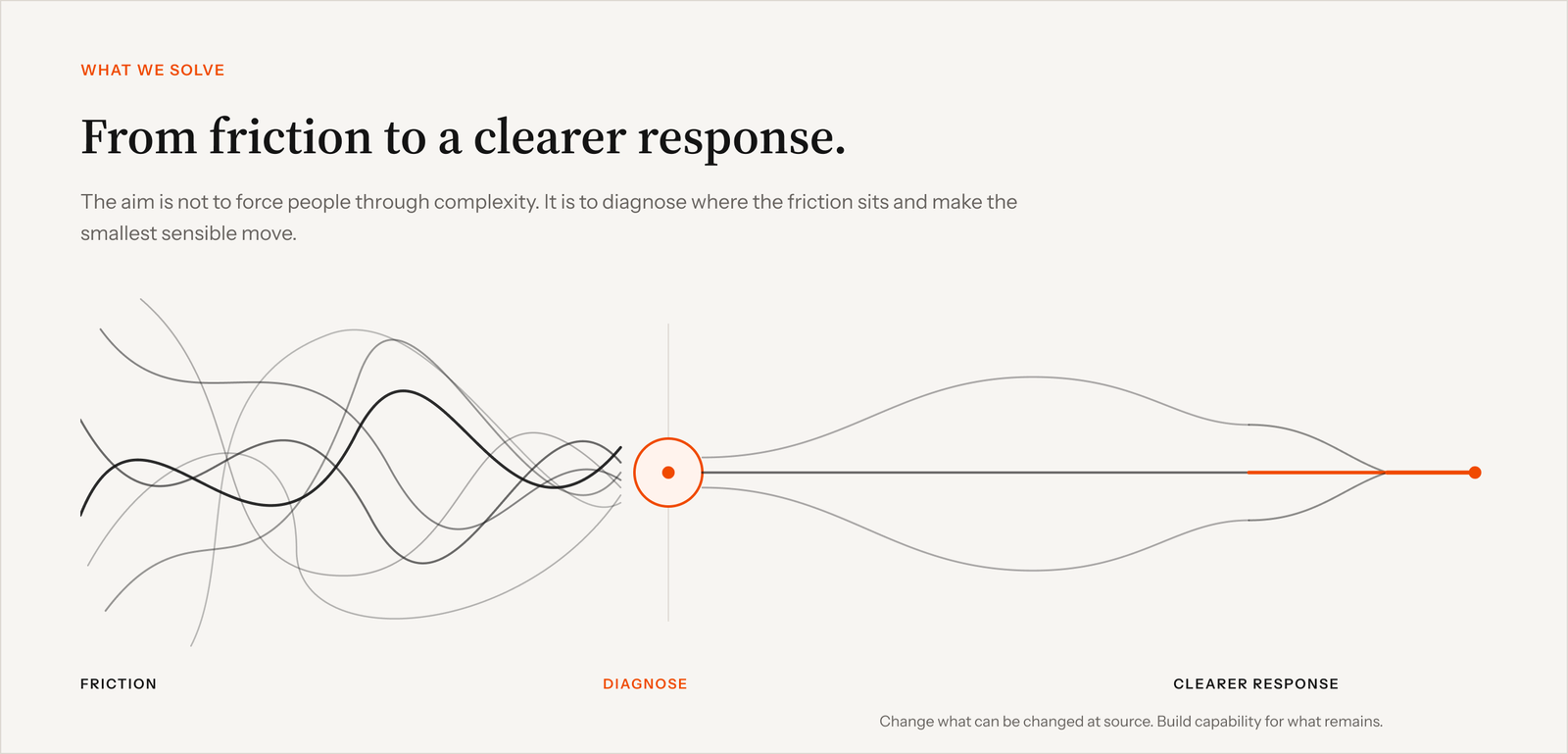
Sometimes the right response is relatively small: clarify a responsibility, remove a poor handoff, change a decision point, develop a specific capability, or test a different way of working with one team.
Recognise something here?
The right next step depends on whether the problem is clear, how widely it appears and what has already been tried.